Point AI at the bottleneck in your business and do more with less of you.

Want to find the highest-leverage places to put AI to work in your business? Tell us a little about the outcome you are trying to create.

You are key to what makes the business work. You are also the constraint holding it back.

You close the accounts, make the call on every product, or know what the customer wants before they do.

This is the classic growth pattern: you make the business work, and you are also the constraint. It cannot grow past your calendar and you cannot take a month off.

To scale the business or get back your time, you need systems that let it work without you and make your team more effective. What worked when you started starts to break as you scale.

Example: Executive Search Firm

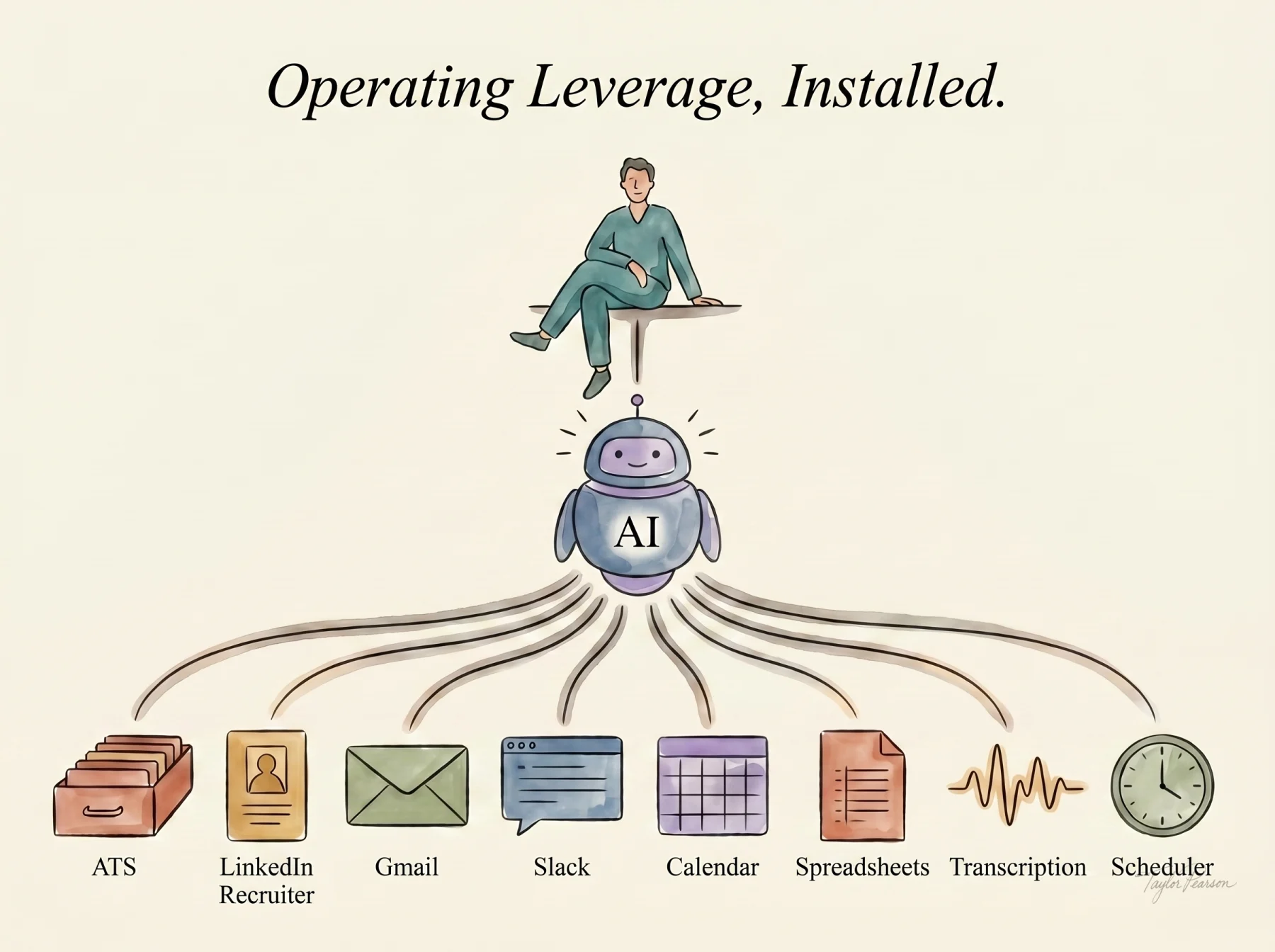
  • The work is scattered across ten tools: an applicant database, LinkedIn Recruiter, Gmail, Slack, a scheduler, a call-transcription app, and spreadsheets.
  • The recruiters are the glue, carrying each candidate from one system to the next by hand.
  • Reviewing one batch of fifty sourced profiles eats about ninety minutes.
  • The background brief on a new client company takes another hour and the sourcing file for a search runs one to two hours.
  • A strong candidate who is wrong for today's role but promising in the future disappears into one record among seventy thousand.

The most valuable people are not spending their time on the most valuable part of the work. They are reconciling records, chasing handoffs, remembering exceptions, and catching process errors after they have already leaked into the system. Change the business and the shape of the problem is usually the same.
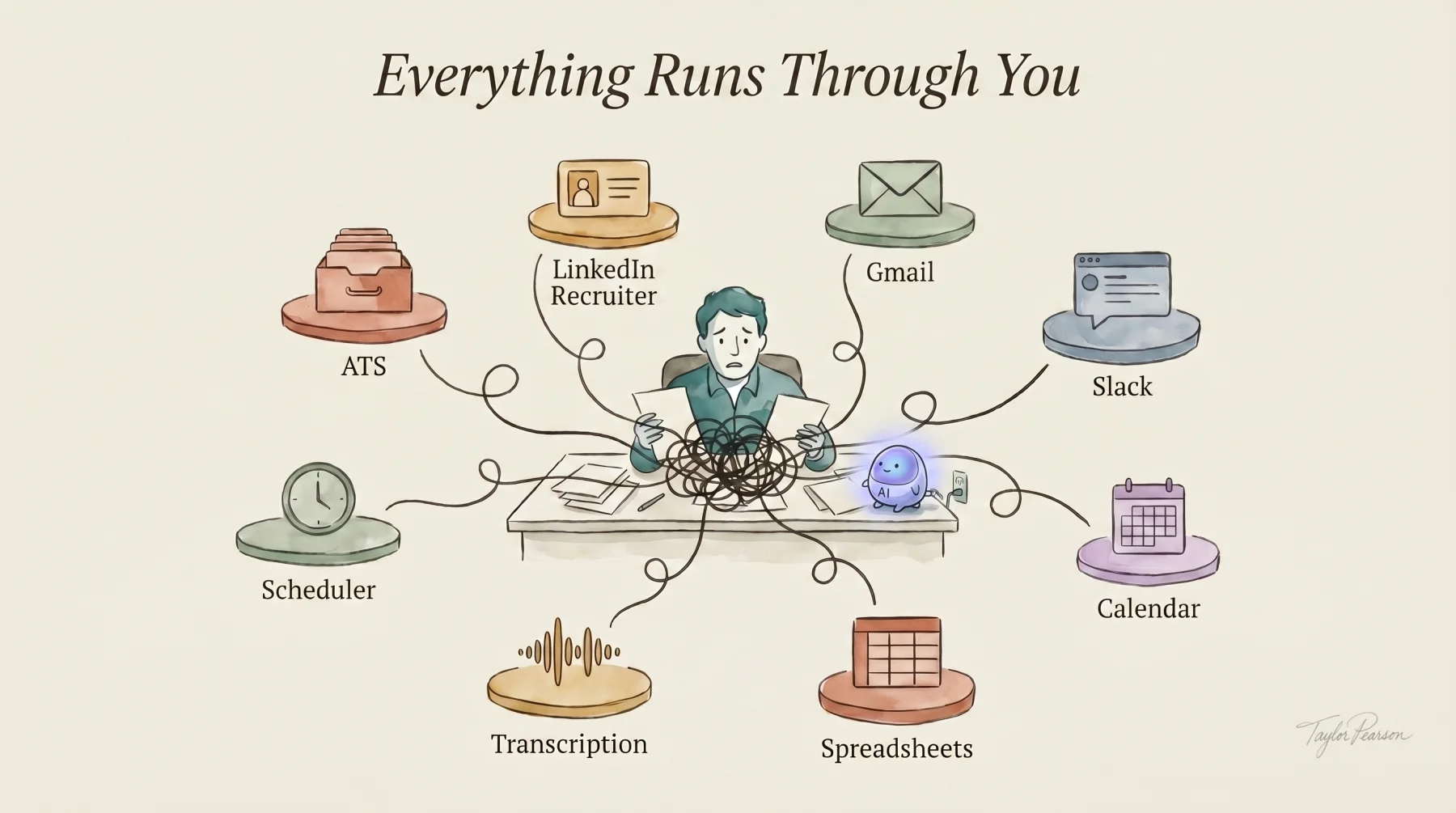
Watercolor illustration of a founder as the hub between disconnected business tools.

AI has made you faster. It has not created operating leverage yet.

What AI has done
  • Made isolated tasks quicker.
  • Helped you draft, research, summarize, and code.
  • Saved hours in a few visible places.
What it has not done
  • Rebuilt the way work flows through the business.
  • Connected the tools, memory, handoffs, and decisions.
  • Created leverage that compounds without you in the middle.

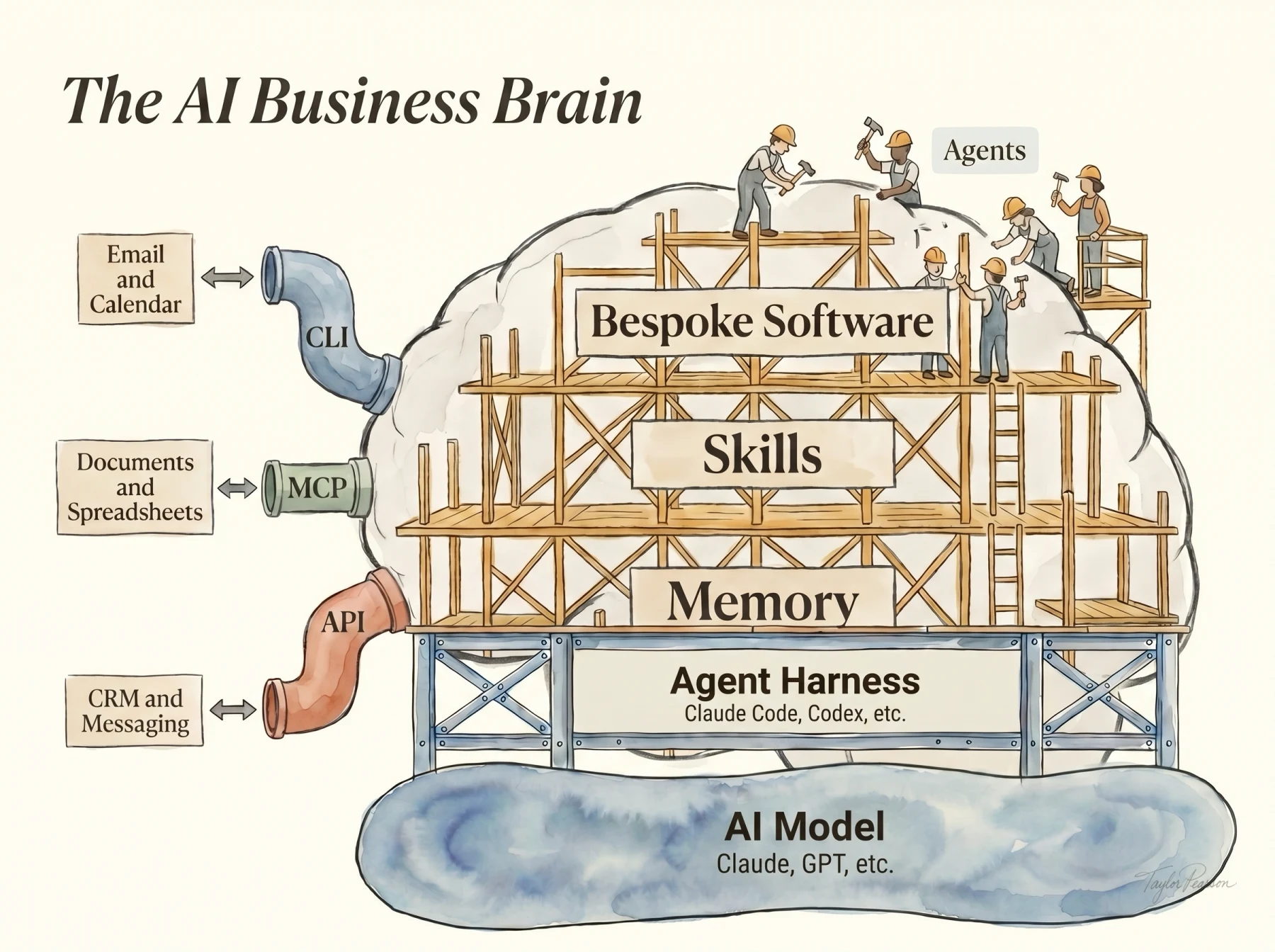
The leverage was never the AI model. It is the Business Brain you build on top.

Most of the discussion is about the newest AI models. The real leverage is the layer you build on top.

Memory that holds your business: your customers, your market, the way you make decisions.

Skills your procedures written for an agent instead of an employee.

Small custom tools for the work that has to come out the same every time.

That is an AI business brain, not just a tool. It is the part that compounds into process power: the kind of advantage a competitor cannot copy.

Diagram of an AI business brain made from memory, skills, and small tools.

AI becomes useful when it is built around your work.

Electricity did not transform factories when owners simply swapped one power source for another. The unlock came when factories reorganized around the new technology. AI has the same shape: the gain is not a better browser tab, but workflows rebuilt around memory, skills, tools, and agents.

Why the factory comparison matters

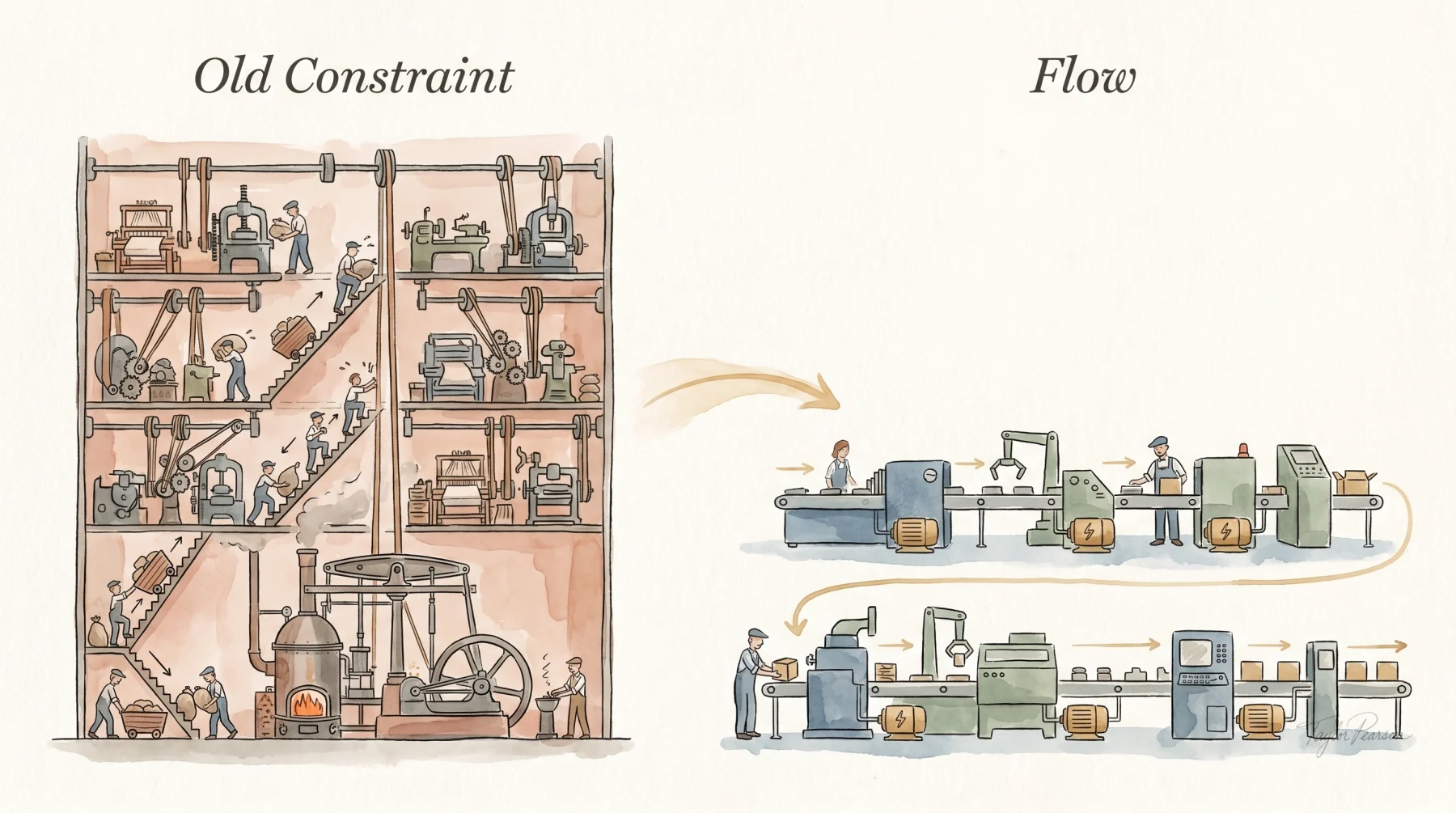
Getting the most out of new technologies requires new ways of working. Steam factories were tall and narrow because one big engine turned line shafts along the ceiling. Machines had to sit close to the shafts, and materials had to be hauled up and down between floors.

When electricity arrived, the first move was to replace the steam engine with one big electric motor and keep the same shafts. The motor was better, but the factory was still organized in a mostly vertical layout which meant hauling materials up and down the stairs.

The productivity unlock came when each machine got its own small motor. The source of power no longer determined the layout and so factories were re-organized into a single, continuous production line where material could move in a continuous flow"

Like electricity, Agentic AI is a general purpose technology. Most people are using it similar to the first electric motor: as an accessory to the way things have always been done.

It can make isolated tasks faster, but the business still has the same handoffs, the same people moving information between tools, and the same owner in the middle. The unlock is a business organized around AI: memory, skills, small tools, and agents built around the way the work actually moves.

Watercolor diagram comparing a tall steam factory constrained by line shafts with an electric factory organized around continuous flow.
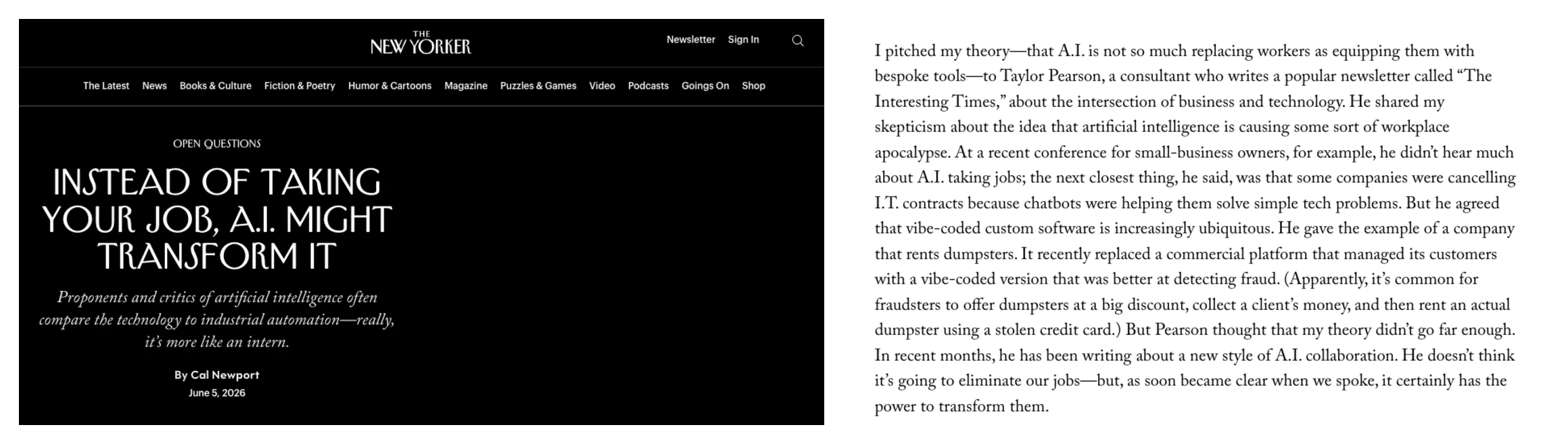
New Yorker article clipping featuring Taylor Pearson.

Taylor spoke with Cal Newport for his New Yorker column on how AI is reshaping knowledge work. The piece's argument, that AI is equipping knowledge workers with bespoke tools, is exactly the layer we install.

More AI activity is not the goal. More business productivity is.

A major problem with implementing AI is that it has jagged intelligence. It can provide a ton of leverage in certain contexts, but be useless, if not actively harmful, in others.

Every business also has different needs and bottlenecks. Automating a process with no business value is worth nothing.

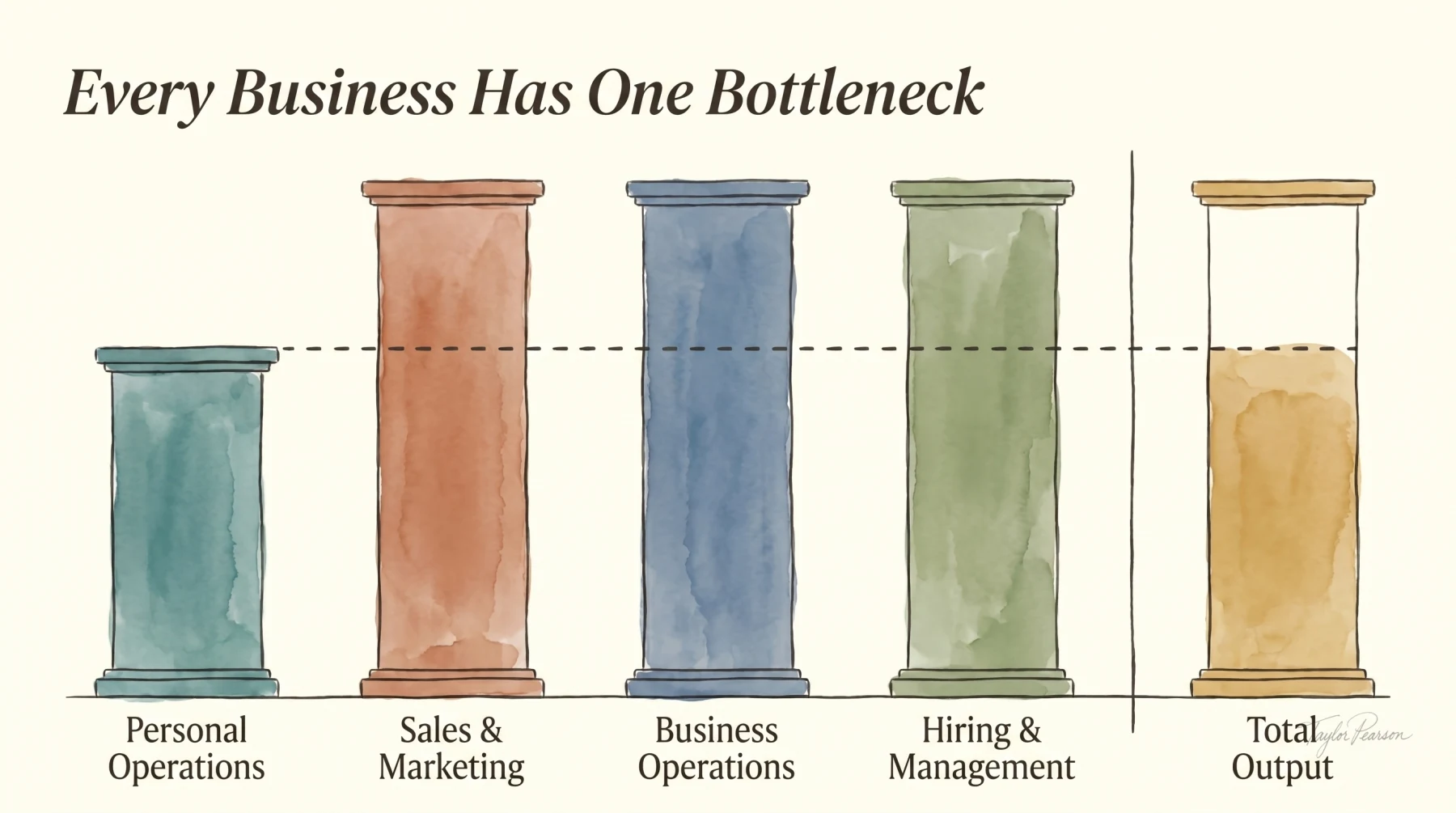
Four business constraints where the shortest pillar caps total output.
The four constraints: Personal Operations, Sales & Marketing, Business Operations, and Hiring & Management.

How can your business get the most leverage out of AI?

Over the course of a month, we'll work with you and your team across a few working sessions where you'll describe, in plain English, how your business actually works.

We'll use our internal systems and agents to look at any documentation or resources you have to get a complete picture of the business.

We use that diagnosis to build a roadmap of the places AI can create the most leverage in your business: what to build first, what to leave alone, and where the system needs human judgment before it touches the workflow.

The business starts doing more without requiring more of you.

Picture the repetitive work running in the background: the intake, the reporting, the document handling, the follow-ups, all happening with your team approving outputs instead of producing them from scratch.

Your own role changes more than theirs. You build a procedure once and it runs every week, across every client, without you in the loop. The business gets faster without getting heavier, because growth lands on the system instead of on another hire.

That's the thing you're actually buying: operating leverage. Your time, converted back into the work only you can do, and a business that no longer depends on you for its throughput. You then get to decide if you want to convert that operating leverage into more time for yourself or reinvest into growing the business.

Watercolor illustration of AI coordinating the operational load beneath a founder.

Operational judgment to find the problem. Technical depth to solve it.

Taylor Pearson headshot

Taylor Pearson

Taylor has spent over a decade coaching and consulting with founders of $1-10M companies through exactly this kind of constraint diagnosis, using the Theory of Constraints as the method. He has been heads down for the last two years on how to use AI to do it even better.

Zakk Fleischmann headshot

Zakk Fleischmann

Zakk has spent thirteen years building and leading engineering teams and helped two companies grow from two people to fifty, shipping the kind of production systems where reliability matters, including the security infrastructure behind a $200 million treasury.

He's since pointed all of that at AI for businesses like yours, building multi-user agent systems for everything from training firms to recruiters. He formerly taught a highly rated course on building Chief of Staff AI agents.

A roadmap you can act on and a working system to prove it.

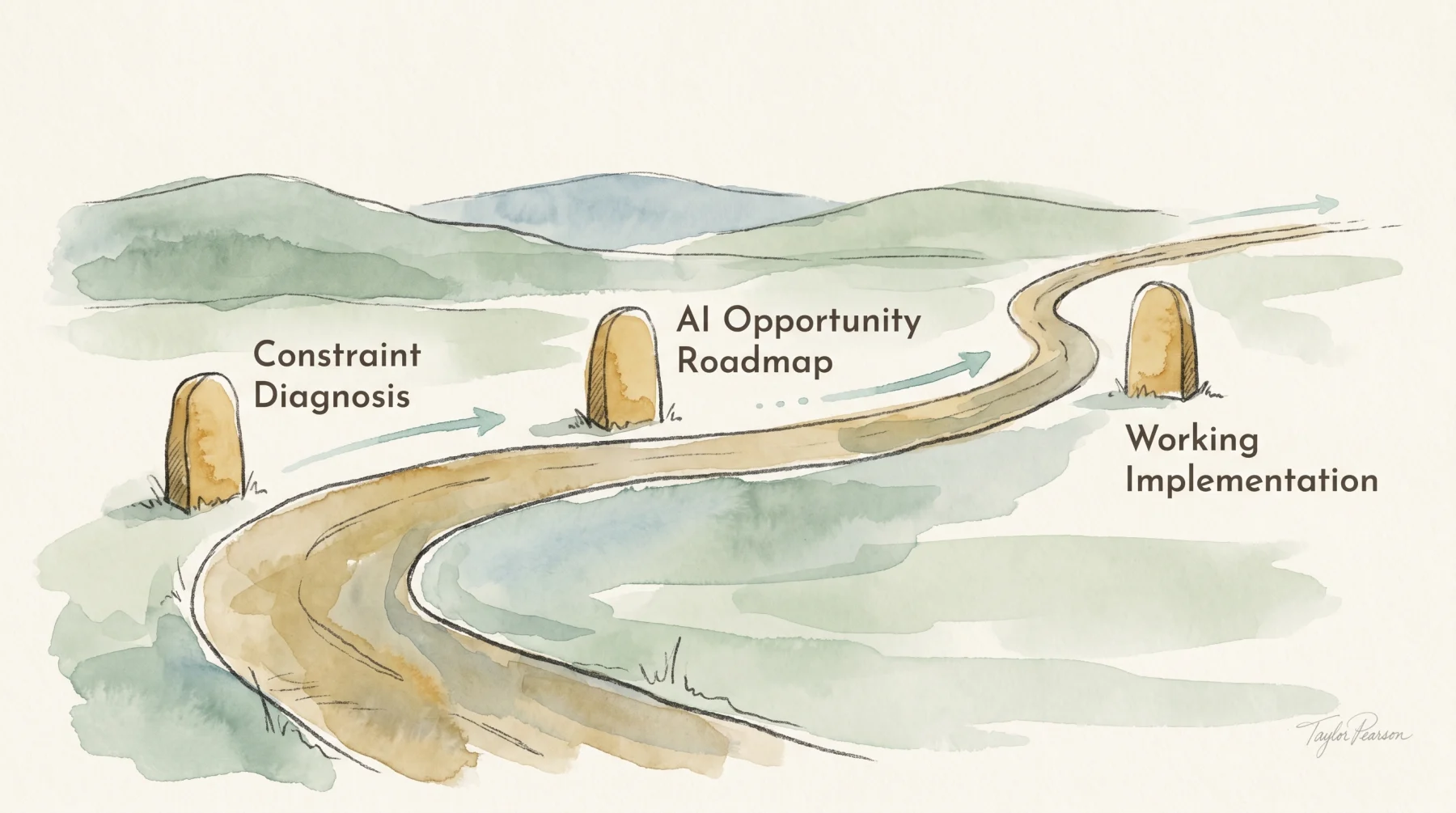
01

Constraint diagnosis

A diagnosis of the biggest constraints in your business so we know where AI can be most effective.

02

AI Opportunity Roadmap

Based on your constraints, we'll identify the highest-leverage places to put AI to work, ranked by payoff and build effort, so you're getting the most benefit from it.

03

Working implementation

We'll build a working implementation of one of your highest-leverage use cases so you can see how it works.

Watercolor roadmap with three milestones: Constraint Diagnosis, AI Opportunity Roadmap, and Working Implementation.
Week 1

Show us how the business works.

You and the relevant people on your team walk us through the business and the tools you use. We'll map the workflow and understand where it drags.

Week 2

Pick the first upgrade.

You pressure-test what we find with the context you have and we'll agree on the major constraints, rank the opportunities for using AI to unlock them, and choose one bounded use case to build now.

Week 3

Put the system to work.

You use an early version on real inputs and tell us where it helps or breaks. We build and refine a work agent inside the way your team already works.

Week 4

Leave with the roadmap and a working skill.

You review the working system and decide what is worth doing next. We hand you the finished roadmap: the constraint diagnosis, ranked opportunities, architecture, and build plan.

After a month, we'll discuss whether you want to implement the roadmap yourself or if we can do it together.

The questions a sensible operator asks before putting AI to work.

My team won't adopt another tool.

There is some adoption. Someone on your team needs to develop an intuition about AI and some of the basic components. We'll help enable that.

But not everyone needs the same relationship with it. The person who wants to get close to the machinery can work in Claude Code or Cowork, building or tuning the skills. Everyone else can use it in Slack, your CRM, or the tools where they already work: ask questions, hand it a job, or review what it produces.

We design that interaction model around the people and their roles. The goal isn't a zero-change rollout; it's the right amount of change for each person, so the system earns its place in the team.

How do I know I'll get ROI from this?

This is what we'll talk about on a preliminary call. Depending on what you want and what we can deliver, it may or may not make sense. Some businesses have a lot of components and processes that could benefit from AI and others don't.

Won't the next model just do all this on its own?

The big models eat the generic, codifiable parts of the work: the stuff that looks the same for everyone. What they can't eat is the local, fast-changing layer: your clients, your constraints, the decisions you made and why.

Building that means the next model only makes your system more powerful. The model underneath is available to everyone. The operating system built around your business is yours alone.

I could build this myself.

You probably could. Tell us about your business and you can evaluate whether it makes sense to do it yourself. We're open to either path.

Case Study: Executive Search Firm Saves Time and Unlocks New Capabilities

01

Problem

An executive search firm where the team works across LinkedIn Recruiter, Gmail, Slack, an applicant-tracking system, call transcripts, and spreadsheets, with more than seventy thousand candidate records underneath it all.

  • Reviewing fifty candidate profiles used to take roughly ninety minutes.
  • Preparing a company-intelligence brief took another thirty to sixty.
  • A sourcing file for a search could take one to two hours.
02

Solution

We mapped the organization's workflow and gave each recruiter an agent connected to Slack and Google Workspace, where they were already working. We built skills that enabled agents to work from reusable templates for the recurring work: kickoff briefs, sourcing files, candidate profiles, submissions, and interview preparation.

  • Every recruiter gets an agent with the company's context and custom skills.
  • The recurring work becomes shared infrastructure, not one person's experiment.
  • The firm can build workflows that generate leverage across the organization.

What thoughtfully integrated AI can unlock

This is how AI actually starts to generate leverage inside a business. It's not a chatbot off to the side, but a system wired into the real work, giving time back first and then doing what couldn't be done before.

The goal is not to replace human judgment about who is right for the role. It is to stop spending that judgment on moving information between systems and assembling the same documents from scratch, and to supplement it with an informed agent to work with.

This is not a magic button. There's a lot of hype about AI running your whole business. We are both on the frontier of what is possible, and we can tell you the useful version is more nuanced and specific: it's about getting it properly integrated into your workflows in a way that frees you up to do higher-level work and gives you new tools for that work.

Done right, the team and the AI together outrun either one alone.

Render unto software that which is deterministic, unto the agent that which is probabilistic, and unto yourself that which is irreducibly yours.

Built for operators who have become their own bottleneck.

This is not for aspiring founders or AI hobbyists. It is for people running a real business who want the output of a bigger team without hiring one.

This is for you if

  • You run or work at an established business, roughly $1-10M and 3 to 50 people.
  • You have already tried AI, but feel like there is a lot of potential to unlock.
  • You want systems built into how you operate, not another course to watch.
  • You want to use AI to get more out of your business, and you are willing to put in a few hours a week with us to make that real.
  • You care about ROI and owning the system, not being cutting-edge for its own sake.

This is not for you if

  • You are early stage/pre-revenue.
  • You want to automate everything and have AI run the business on its own.
  • You are after one-off templates or skills rather than a system built around your business.
  • You will not be involved, or you cannot authorize the work.

A roadmap you can act on. A working implementation to prove it.

If we work together, we'll build an AI Operating Leverage Roadmap.

01

Constraint diagnosis

A diagnosis of the biggest constraints in your business so we know where AI can be most effective.

02

AI Opportunity Roadmap

Based on your constraints, we'll identify the highest-leverage places to put AI to work, ranked by payoff and build effort, so you're getting the most benefit from it.

03

Working implementation

We'll build a working implementation of one of your highest-leverage use cases so you can see how it works.

Watercolor roadmap with three milestones: Constraint Diagnosis, AI Opportunity Roadmap, and Working Implementation.

One honest constraint

We do have limited capacity and are taking on three more companies for the summer. This is an involved process and we want to get it right before we scale it to others in the Fall.

No risk on the call

The call is genuinely a discovery call where we see if this makes sense. Some businesses benefit more than others and we want this to be a slam dunk. We'll try to make sure you walk away with a few good ideas worth running with, whether or not we end up working together so it's worth your time.

A short form — if it's a fit, we'll set up a free 60-minute diagnostic call. You'll leave with a few good ideas either way.

Sooner or later you will do this. The only question is whether you are early or late.

A few years from now this will not be an edge. Every business in your category will run on some version of it, the way they all eventually got websites and a CRM. The advantage goes to whoever builds the understanding first, because the context compounds.

Fill out the form and tell us what you are trying to create. We review every inquiry personally. If it looks like a fit, we'll get in touch to set up a time to chat. If it isn't, we'll tell you and point you toward what would help instead.

Start here

Request your diagnostic call →

Start with the short form. Tell us what you are trying to create, and we will follow up with the right next step if it looks like a fit.

The roadmap is the start.

For some businesses, the roadmap is the start of something longer. Once you can see the map, the natural next step is the build, installing the system. We will talk to you about whether that is something you want to manage or we can manage it for you.